sdfb

WELCOME TO GORGIAS PRESS
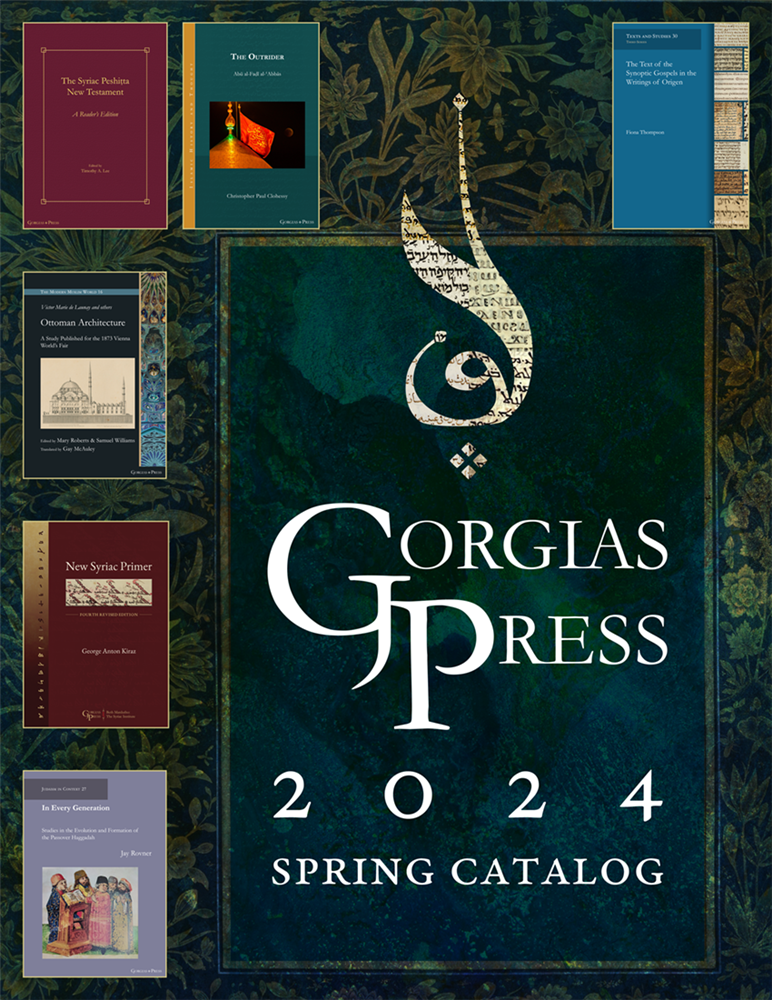
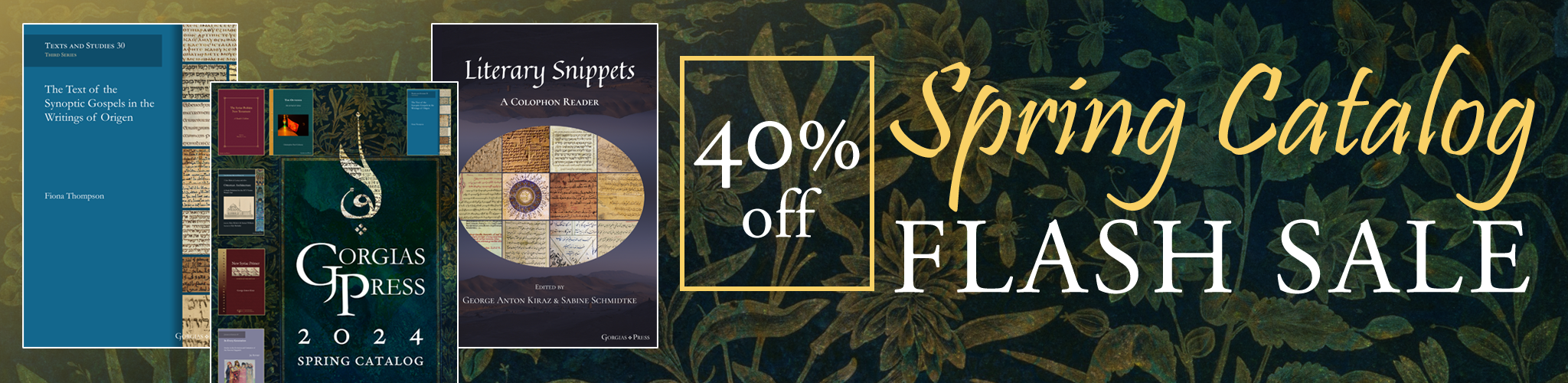
Sales: Save 40% across all categories in our NEW CATALOG SALE, from 30 April to 20 May*. This sale includes new, forthcoming, and classic titles.
*All sales discounts are automatically applied to qualifying titles. Some titles are excluded for contractual reasons.
Some titles are available at 70% off due to minor imperfections as part our imperfect booksale. View the 70% off titles here. Email gemma@gorgiaspress.com to reserve your copies.
Featured Categories


Featured products

The Lexical Profile of the Suras (vol. 1)
By Elie Wardini
Series: Gorgias Islamic Studies 22
ISBN: 978-1-4632-4649-5
The aim with the present series, The Quran: The Lexical Profile of the Suras, is to present key data related to the lexicon of the suras of the Quran, in terms of Key Word distribution and lexical associations within each sura. The digital text used for this purpose is the Uthmani text of the Tanzil Quran Text. All vocalized Arabic text is quoted unaltered in any shape or form from the Tanzil text. Unvocalized Arabic text and transcriptions are my own. The Key Words are always referenced by their lemma and are sorted alphabetically according to Arabic and UNICODE order with minor adjustments for consistency. In lemmatizing the words, no attention has been given to the semantics of each word. Only on rare occasion have similar forms of words or proper nouns been separated in order to avoid confusion. In assigning each word a lemma, Classical dictionaries and Quran commentaries, as well as modern Quran dictionaries have been consulted.
$189.00

The Lexical Profile of the Suras (vol. 15)
By Elie Wardini
Series: Gorgias Islamic Studies 22
ISBN: 978-1-4632-4677-8
The aim with the present series, The Quran: The Lexical Profile of the Suras, is to present key data related to the lexicon of the suras of the Quran, in terms of Key Word distribution and lexical associations within each sura. The digital text used for this purpose is the Uthmani text of the Tanzil Quran Text. All vocalized Arabic text is quoted unaltered in any shape or form from the Tanzil text. Unvocalized Arabic text and transcriptions are my own. The Key Words are always referenced by their lemma and are sorted alphabetically according to Arabic and UNICODE order with minor adjustments for consistency. In lemmatizing the words, no attention has been given to the semantics of each word. Only on rare occasion have similar forms of words or proper nouns been separated in order to avoid confusion. In assigning each word a lemma, Classical dictionaries and Quran commentaries, as well as modern Quran dictionaries have been consulted.
$216.00
LIBRARY AFFILIATE